
An important person in the history of healthcare information systems, who shall remain nameless, put me on a career path that evolved over the years and carried me along until my retirement. After I had worked with him on some very interesting projects, including my first exposure to the IBM PC, he asked me if I was interested in taking over the evaluation and approval of computer peripherals for our software system. I could see that for him it was busy work, but for me it was an opportunity I couldn’t resist, and I pursued it enthusiastically.
I became immersed in the products and technologies of terminals, printers, modems, statistical time-division multiplexors and data PBX’s, with a very heavy emphasis on data communications and serial interfacing. Network configuration and troubleshooting was added to the mix a couple of years later.
Working with manufacturers and distributors, hardware came in the door with the understanding that, if approved for use by our customers, we’d hold onto it for support purposes. My philosophy was to always take first crack at every customer problem, which was best done by having the gear on hand. That way, we could determine if a problem was ours to fix without finger pointing. If we needed to point a finger elsewhere, we could explain exactly why. If we weren’t certain, we would at least know in which direction the next step of the troubleshooting process needed to go.
At that time, there were dot-matrix printers of various sizes, gigantic band printers (also called line printers) and table-top daisy-wheel printers. The print quality of the first two technologies, almost always on perforated fanfold paper, was serviceable. A daisy-wheel printer with a cut-sheet paper feeder had quality that was almost comparable to an IBM Selectric typewriter, but it was agonizingly slow. Also, all of those printer technologies were VERY L-O-U-D!
After I’d been settled in my new role for better than a year, one of the software bosses said he was interested in high-quality, formatted printing for an office system that was under development. It had to be faster and quieter than the daisy-wheel printers. He was in luck, as Hewlett-Packard had just announced the first generation of its LaserJet.
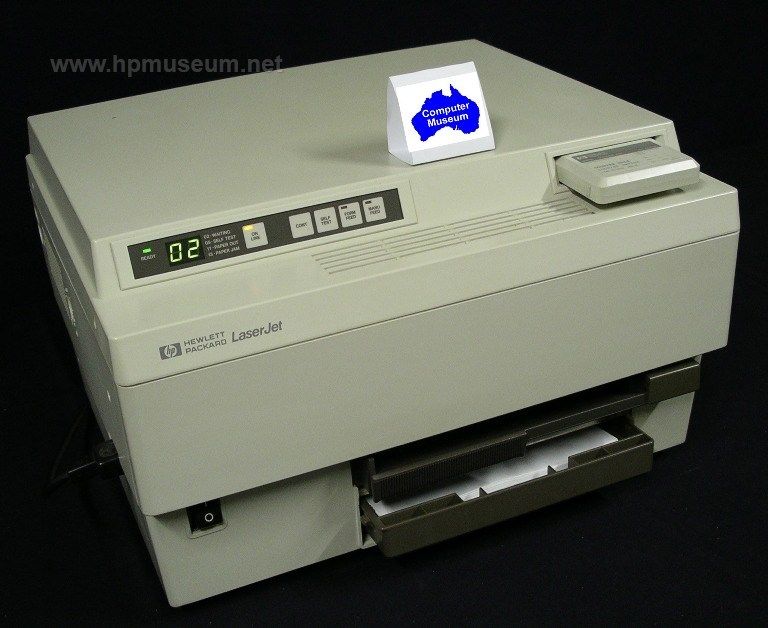
The HP LaserJet was introduced at the low, low price of $3500, equivalent to about $10,000 today. It wouldn’t cost me anything to try one, so I arranged for delivery of an evaluation unit and we got to work. Considering how quickly we acted, it’s safe to say we were very early in announcing support for the HP LaserJet.
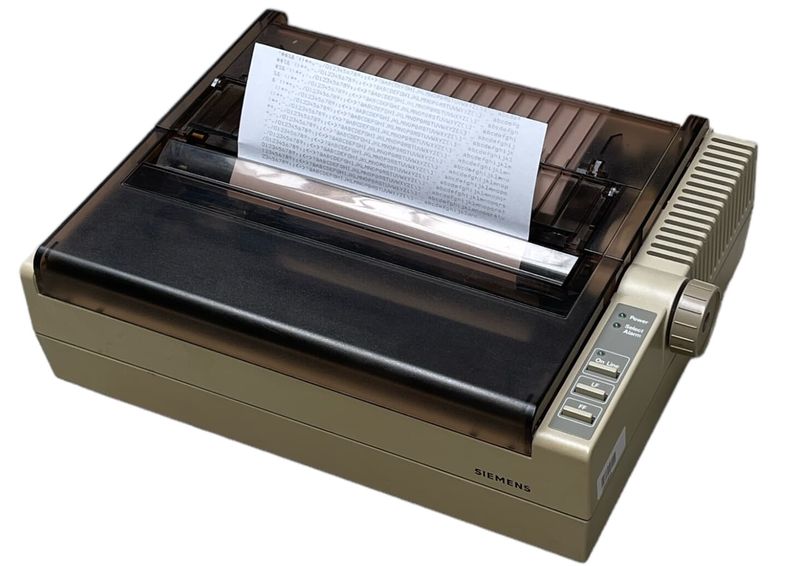
Around the same time, I was contacted by a distributor for Siemens. He wondered if I’d be interested in their cutting-edge PT-88, with inkjet printing. It printed in any color you wanted, as long as it was black. From my business travels to hospitals, I knew that nurses weren’t fond of noisy dot-matrix printers, especially in the ICU. The compact and whisper-quiet PT-88 seemed like a good option for them, so I had one delivered. It worked fine without any special software, making it an easy addition to the support list.
Today in my home office I have a 20-year-old Samsung laser printer and an 18-year-old Canon inkjet printer.
There’s another class of printers, called thermal transfer. Those were/are in widespread use for barcode labels, and I had no say in what was supported. Whatever thermal printers a hospital happened to be using, we had to make them work. Which reminds me of another story for later. The Case of the Melted Case.