
It’s funny because it’s true.
Category: Politics, Religion & Money
Scratching the Old A/V Boy Itch – 2
Plan B for having access to my cable TV DVR from the porch was a total flop. This was Plan B.
I had my doubts about wireless HDMI when first considering it seven years ago, before choosing to buy the OTA TiVo instead, and those doubts have been confirmed. Based on hours of experimentation, in my opinion wireless HDMI is suitable only for a line-of-sight connectivity in the same room.
Communicating through a wall or floor doesn’t work, even when the total distance is only ten feet. Worse, the 5 GHz range of frequencies that wireless HDMI uses for peer-to-peer communication, without benefit of a hot spot or router, can interfere with a 5 GHz Wi-Fi network. Yesterday, while the transmitter and receiver kept trying to establish a connection, devices would disconnect from my Wi-Fi extender. Once I realized that was happening I gave up, disconnected the wireless HDMI transmitter and receiver, and put everything back in the box.
Having been a few years since I returned something to Amazon, today was my first time using the self-service return process at an Amazon-owned Whole Foods. First I initiated the return online and downloaded a QR code JPG to my phone. At the store kiosk I scanned the code, then put the box in a bag and slapped on a label the machine printed before dropping it into the kiosk.
This evening I received a text message confirming the return has been processed, with the refund coming within 7 days. By coincidence, this week’s New Yorker has an article about the business of returned purchases.
https://www.newyorker.com/magazine/2023/08/21/the-hidden-cost-of-free-returns
Cartoonomics

“By Word of Mouse” is a Warner Brothers cartoon I watched as a kid. Perhaps it had more of an influence on me than I realized, beyond Hawley Pratt being the layout artist.
https://pinkpanther.fandom.com/wiki/Hawley_Pratt
This video cuts out part of the cartoon in an attempt to keep YouTube from deleting it.
This video includes the parts about Microeconomics that are missing. The 1950’s emphasis on mass production and consumption doesn’t mention the corollary, planned obsolescence.
He’s King Midas in Reverse
Trump has been indicted again, but this time it’s the big one, about the January 6 insurrection. His new defense strategy is to blame Rudy Giuliani, Sidney Powell, and Clarence Thomas protégé John Eastman, while at the same time insisting he did nothing wrong. It’s their reward for being loyal.
Trump continues to be the likely 2024 Republican candidate. Like moths drawn to the flame, Republicans are refusing to see that he is throwing the entire party under the bus. How’s that for a mixed metaphor? It must be true that you can fool some of the people all of the time.
Having a Mitch Moment
At age 88, my father was in denial about his condition. He acknowledged that he was “slowing down,” but that was as far as it went.
I joined my sister who is an M.D., and my sister who is an R.N., to have the “it’s time” talk with our father. It was time for him to move to an assisted living facility, which he angrily refused to even consider. A month later he suffered a massive stroke, instantly turning my life inside out. Ten months later he was gone.
One of my father’s neighbors told me there had been an incident months before Dad’s stroke. He saw Dad sitting in his car in the middle of the street, so he went outside to check on him. Dad was disoriented, failing to acknowledge the neighbor by name, and he couldn’t remember which house was his. The neighbor pointed to the house, and Dad recovered enough to get the car into the garage. My father had a Mitch Moment, probably due to a mini-stroke, according to my sisters.
My guess is that McConnell forgot where he was. After recovering from whatever hit him, McConnell insisted that he was fine, but everyone can see that he isn’t. McConnell needs to be told what no elderly person wants to hear, “It’s time.”
Mitch should resign, effective immediately, as should Dianne Feinstein. Biden’s mental acuity seems mostly okay for now, but he should drop his bid for re-election, and Trump isn’t far behind in age.
The Corner of Wall and Main
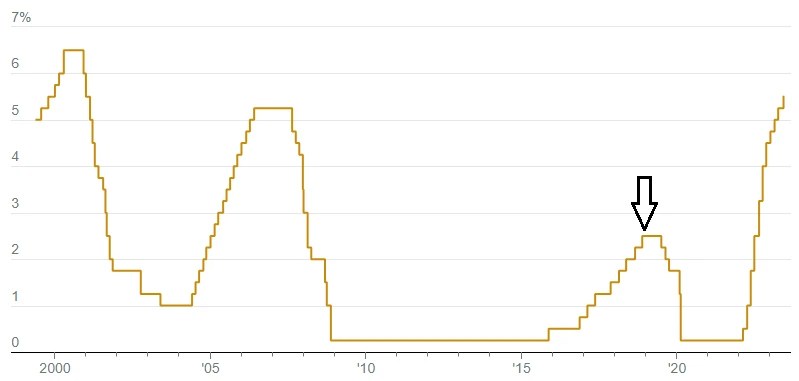
The Fed has added another quarter point to the federal funds interest rate, nudging it up towards 5.5%. This is bad news for individuals carrying variable rate debt, and those who are applying for a loan. It’s good news for me, because my retirement money is in local banks that are offering attractive CD interest rates.
This is the upside of inflation for risk-adverse retirees who are feeling the pinch of rising food prices. Finally, the financial sector isn’t skewed 100% in Wall Street’s favor and, whatta ya know, Wall Street is still doing fine.
For almost fifteen years, the easy money policy of the Fed gave Wall Street at least two advantages. First, money could be borrowed for free, tempting brokers to make risky speculative investments of the sort that contributed to the crisis of 2008. Second, there was a massive transfer of money into equities from commercial banks, because regular bank accounts paid nothing. Savings accounts are actually “losing accounts.”
The arrow in the graphic shows the last time I locked in an interest rate for my IRA CD’s. The pre-Covid rate of 2.5 percent wasn’t much, but it was a big bump up from what the rates had been, following the crisis of 2008. If the interest rate had stayed at zero, I would have given up the safety of bank CD’s for index funds. For now I can safely remain a contrarian, and a true financial conservative.