From IEM to AI and AIM

Jack Kirby now has a New York street named in his honor.

Jim Steranko at Jack Kirby Way

Advanced Idea Mechanics, AIM, was created by Jack Kirby to oppose another one of his creations, SHIELD. An organization of brilliant amoral scientists and engineers, wearing outfits lifted from Dr. No, AIM didn’t see itself as being necessarily evil or good. It was simply working for itself, as if the only goal of the Manhattan Project in developing the first atomic bomb had been to prove it could be done.

Where AIM screwed up was in creating Modok. He was supposed to serve the aims of AIM, but he quickly dominated them and took over the organization. You can see where I’m going with this, regarding Artificial Intelligence.

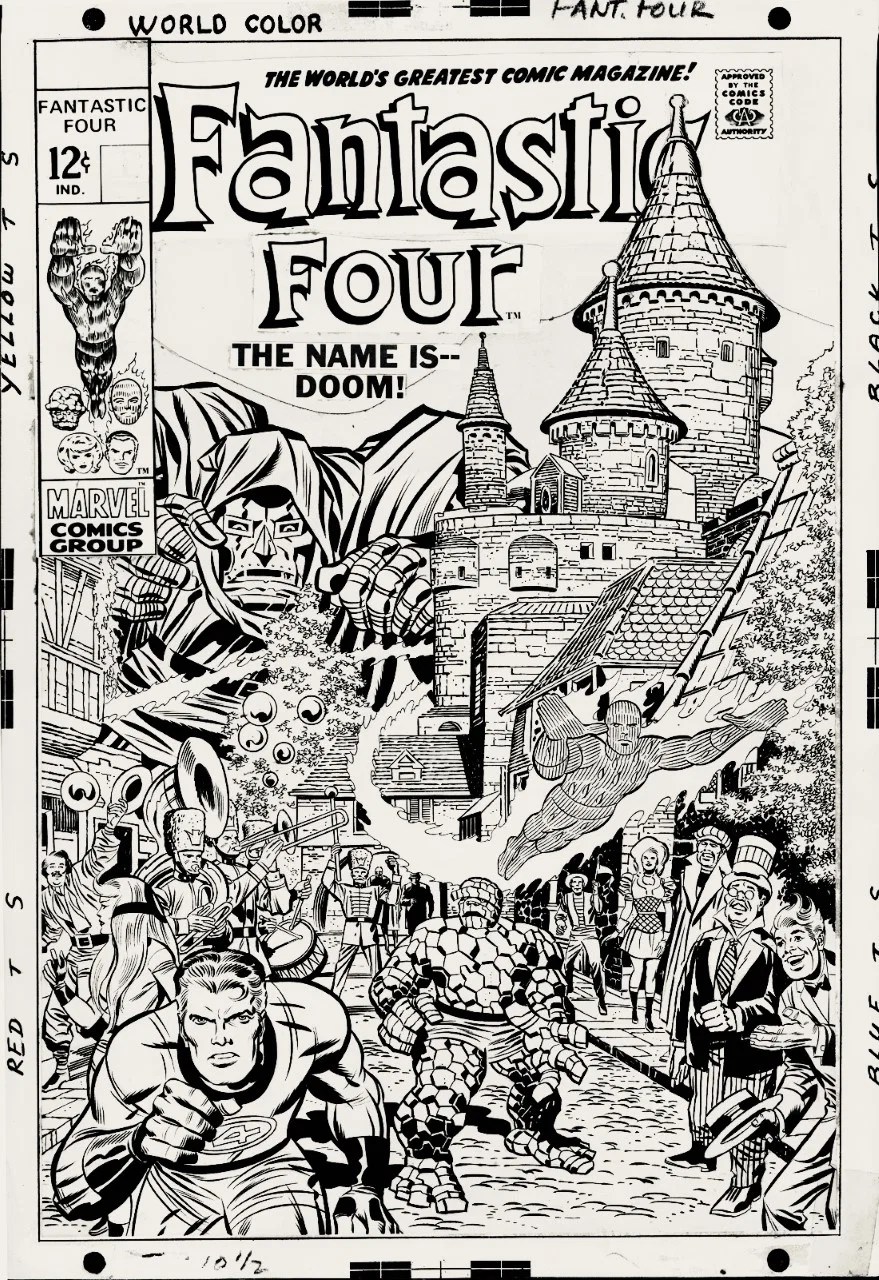
From Tales of Suspense #94, Jack Kirby (pencil) with Joe Sinnott (ink)

Right now I’m listening to American Top 40 on SiriusXM, with one of my ten pairs of inexpensive wired IEM earphones. I enjoy making comparisons between them.

Today’s listening selection is with the first version of the 7Hz Salnotes Zero IEM. (There’s a second version that I also have.) I came upon this website with a review of the Salnotes that I hadn’t seen before.

https://audioreview.frieve.com/products/en/7hz-salnotes-zero/

Frieve Audio calls itself, “An audio company and product meta-review site that surveys dozens of sources worldwide and publishes reviews that can be treated as final conclusions.” I’m pointing this out because Frieve is obviously a work of AI that’s dependent upon other sources, most notably Audio Science Review.

The process of AI’s recursive consumption and regurgitation of its own sh*t will eventually prove the old adage of garbage in, garbage out. If it isn’t doing that already in some areas of interest.

Exciting All EPSON Blog Post!

I continue to obsessively play experiment with the new Epson ET-2985 printer/scanner. Thanks to the low cost of ink tanks vs. ink cartridges, I’m not afraid to do some printing for fun.

This is a high-resolution image that I thought would be good for a printer test. (Enlarge everything here, of course.)

Painting by Norman Saunders based on a drawing by Bob Powell

The top print was made on regular copier paper. The bottom is on matte photo paper/card stock. You can see the better quality paper is a superior white.

Photo taken with Google Pixel 8a

This test was very interesting. When I went downstairs to check on the printout that specified matte photo paper, it hadn’t yet printed. The tiny display screen was asking for confirmation that the special paper was installed. Very impressive. After confirming, it started printing.

The most obvious difference between the two prints is the color shift in Robin’s cape and, especially, his vest. The regular paper on the left is a better match for the original image, but I prefer the way it looks on the thicker paper.

Now I will turn my attention to the Epson EF12 mini-cube projector I bought a few years ago for $700. That’s the cost of two replacement lamps for the vastly superior JVC projector I bought in 2013. (It was delivered on “Shelter in Place Friday,” after the Marathon Monday bombings!)

The JVC lamps last up to 2000 hours, while the Epson has a laser that lasts up to 20000 hours. Considering the JVC has 6000 total hours of use on it after thirteen years, I’ll undoubtedly be dead before the Epson’s laser wears out. Technology marches on.

I finally have a copy of the complete 1966 Marvel Super Heroes cartoons that’s worth keeping. I’ve been playing them on the EF12 from a USB stick.

Given the superior quality compared to previous bootleg collections taken from VHS copies, the cartoons must have been ripped from a UK DVD set, which is the only official DVD release the series has ever had.

Animation frame adapted from a drawing by Jack Kirby and Chic Stone

Not every cartoon looks that good, but even the lesser quality prints are good enough for me to no longer wish for an official release from Disney. The cartoons have excellent voice work and music, and I enjoy the very limited animation that’s based on stats from the comic books.

There are, however, some embarrassingly bad scenes with original animation, not taken from the comics. I must agree with Denro, who said, “You may have identified why the series hasn’t been released in hi-definition in the US.”

Drawing by … Roy Lichtenstein? 😉

P.S. I forgot to mention the projector screen is also from Epson. The ES3000 cost $200 when I bought one in 2013 to go with the JVC projector. The screen is still available today, but it now costs $330.

Gwen Stacy’s “Killer”

Very few comic book Silver Age professionals survive, and even the ranks of the Bronze Age creators are thinning. One of them was Gerry Conway, a writer whose work, frankly, didn’t do much for me.

https://www.nytimes.com/2026/05/01/arts/design/gerry-conway-dead.html?unlocked_article_code=1.fVA.Z4-d.TW7D-FJKKqQ5&smid=url-share

Conway wrote the Spider-Man story where he killed off Gwen Stacy. The earlier death of Gwen’s father, Captain Stacy, worked well, as scripted by Stan.

But for me, writing Gwen out of the series made as much sense as Betty disappearing from Archie comics. The move came across like a gratuitous fanboy idea, intended for shock value. There were other, better, ways the love triangle with Mary Jane could have been resolved.

But I was cool to Conway’s writing pretty much from the outset, before that one notorious Spidey story. I wasn’t big on Len Wein or Marv Wolfman either. For me, their comics were a step down from those written by Stan, Roy, Steranko, Gary Friedrich, Archie Goodwin, and Denny O’Neil, among others. Perhaps it was because I was older and better able to consider things more critically.

Soon after Gwen was killed off, Gerry introduced the Punisher, a truly sadistic character. It took a long time for me to appreciate the character, and that was only on TV, not in the comics.

Scan-dalous!

I could never deny being an obsessive fiddler with settings. I’m playing with every possible way of adjusting the Epson scanner. The automatic setting does some things almost as well as the Canon did.

The processing on this scan is bright and de-screened, while effectively reducing the yellowing of the paper. The problem is a sharpening filter was added, and I really dislike that.

Enlarge this image and you can see there are ridges around everything, including the lettering. If I could disable that, I’d be pleased with this quality. Yeah, I know. Picky, picky, picky.

This is how it looks with only de-screening.

Loki Strikes!

Screen grab from 1966 Marvel Super Heroes TV cartoon

Loki, Thor’s wily half-brother nemesis, sabotaged the new printer. Less than a day after setting it up, there was striping.

A test print revealed a problem in the blue nozzle. I ran the nozzle cleaning maintenance process on the printer, thereby defeating the Norse god of mischief.

Fun With Phones and Wi-Fi

I can’t imagine being able to control the scanner from my phone is an option I’ll need often, but it’s nice to have.

This is a painting I bought from Colleen a long time ago. That’s Kovar, a character in her graphic novel series, ‘A Distant Soil’.

Painting by Colleen Doran

Here’s how the scan looks after a bit of tweaking that I wouldn’t have bothered doing with the old scanner. The adjustment overdoes the lighting a bit.