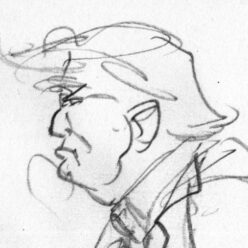

The always wonderful Miss Petula Clark will be appearing in concert Saturday night, in San Francisco.
The always wonderful Miss Petula Clark will be appearing in concert Saturday night, in San Francisco.

Mark Evanier isn’t a big fan of Alfred Hitchcock. But, then, he doesn’t like cole slaw either. Hitchcock is my favorite director, at least up to Psycho, but Evanier considers even that movie a disappointment.
Hitchcock can, I suppose, be categorized as a genre director of thrillers; but that would be the same as saying John Ford was a genre director of westerns, or Frank Capra specialized in screwball comedies.
NPR has a feature on a new book about the music in Hitchcock’s movies. Click here to hear. The audio player below has Bernard Herrmann conducting a brilliant arrangement of his music for Psycho, 14 minutes long, that I transferred from an old LP.
[audio:http://www.dograt.com/Audio/FEB07/Psycho.mp3]Here is actor Alan Rickman…

…and below is Beatles recording engineer Norman Smith, who was a recording artist himself under the pseudonym Hurricane Smith.

From Recording the Beatles © 2006 Curvebender Publishing
[audio:http://www.dograt.com/Sounds/Wordpress/DEC06/OhBabe.mp3]Norman Smith first joined the Abbey Road staff in 1959 as an assistant and quickly progressed to Balance Engineer. He served as the Beatles’ engineer from their Artist Test in 1962 until the completion of Rubber Soul in 1965. In addition to every album made during that time period, he also engineered all of the accompanying singles, including such standouts as “She Loves You”, “I Want To Hold Your Hand”, “I Feel Fine”, “Day Tripper”, and “We Can Work It Out.” Nicknamed “Normal” by the group, he left the engineer’s seat in 1966 when he was promoted to EMI’s A&R department (assuming George Martin’s former position as the head of Parlophone). From there, he went on to produce Pink Floyd’s first two albums — Piper at the Gates and A Saucerful of Secrets — as well as notable work with The Pretty Things. Smith also tried his hand as a recording artist, and in the early 1970s he scored a #3 US hit with “Oh Babe, What Would You Say?” using the alias “Hurricane Smith”.

It’s here! It’s here! It’s here! For $100 this book is a giveaway, depending on your level of interest. And anybody wanting it would have that interest. Don’t know if I’ll be blogging much for the next day or so!
Boston’s commercial Classical music radio station, WCRB, is struggling at its new frequency, according to a recent news account, as seen below. The moment it left its original frequency can be heard here.
Meanwhile, public station powerhouse WGBH is now offering its HD Radio all-Classical music channel on the Net. Bravo. Way to go. Encoding runs at 128 Kbps, and it sounds fine. I just added this link for it on my Windows desktop.
Reception is mixed to new WCRB signal, programming
By Clea Simon, Globe Correspondent | January 25, 2007
Is WCRB-FM fading out?
While the Dec. 1 move of the commercial classical station’s frequency, from 102.5 to 99.5, has made tuning in troublesome for some listeners, changes in the station’s programming have raised other questions. In Boston’s classical music community, the reception to both the signal and the revived station has been mixed.
Continue reading All-Classical WGBH
As told back in October (before I figured out how to do embedded audio and video right), I was once a huge fan of Randy Newman, back in his satirical days. Newman is in Newsweek, and I caught him today on BBC radio, talking about his new composition, “A Few Words in Defense of Our Country”.
Newman’s never-great singing voice seems to be failing him, so he just talks his way through this, and it isn’t one of his catchier tunes, but it’s good to have him despairing over Presidential politics enough to write about it.